Barcelona
Among the very nice architecture in Barcelona, many of the most famous buildings were designed by catalan architect Antoni Gaudì, in the Art Nouveau style, called Modernismo in Spain, during the first half of the 20th century.
La Pedrera
Among the buildings designed by Gaudì, the first I saw is La Pedrera, a collective housing building also called Casa Milà.


 Its facade is undulating, and the flats are also free from an orthogonal structure. Gaudì designed the building up to all its details.


 A furnished flat is open to visitors. The attic has a structure based on catenary arcs and holds an exhibition about Gaudì.


 The terrace is a unique place, with an irregular floor, structures adorned with broken ceramic tiles, and surprising chimneys. It opens on the patios.
Park Güell
 The Güell Park is a big garden above Barcelona, designed by Gaudì. It contains assembled stone furniture and columns, and numerous elements lined with broken ceramic tiles called trencadís.


 A house which was Gaudì’s residence is located in the park. One of the most famous elements is a belvedere terrace rimmed with a bench tiled with broken ceramic.

 The terrace is above the entrance of the park, where two pavilions are located, one of them with a ceramic-tiled spire. There is also a covered alley with tilted columns and a curved portion.


 Close to the entrance, you discover that the terrace rests on columns. The ceramic-lined roof includes colourful medallions.
 The most famous part of the park is a fountain in the shape of a ceramic-lined dragon, placed above a pond between the stairs of the entrance.
 Sagrada Família temple
The Sagrada Família is a basilica which has been under construction since 1882, designed by Antoni Gaudì.

 In 2007, the apse, two facades and the nave have been built. The Nativity facade is teeming with detail, and the Passion facade includes impressive sculptures.


 Once through the entrance door, you discover the finished part of the temple, its stained-glass window, the roof of the nave.


 The aisles support benches. A spiral staircase goes up along the wall. It is possible to climb up the towers of the Nativity facade.

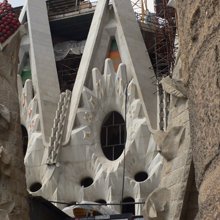
 The towers and columns are topped by decorated pinnacles. While climbing down the towers, facades and the rose window of the temple can be observed.


 The temple is a construction site, and the machines and workers are busy. An exhibition includes explanations and scale models.
Casa Batlló
 The Casa Batlló is a residential building designed by Gaudì in 1905 for a rich family on the trendy Passeig de Gràcia avenue, with flats above the main flat of the Batlló family, an attic and two big terraces.

 Its undulating facade is lined with a mosaic of broken ceramics, includes surprising windows and a ceramic tiles roof.
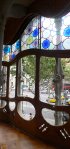

 From the ground floor, a grand staircase allows access to the noble floor and to the main room with its swirling ceiling.


 On the same floor, the dining room has an embossed ceiling and opens on the terrace decorated with ceramics.


 The facade on the terrace side is less colourful but as undulating as the main one. A stairwell with a sea inspiration allows access to the flats.


 The shared attic has whitewashed walls and a catenary arcs structure allowing light in.


 On the roof, chimneys watch over the terrace, where you can admire the other side of the rounded roof and its ceramics decorations.


 Everywhere, construction details are superb, woodwork as well as other materials, down to the sidewalk floor tiles.
Barcelone also has old neighbourhoods including the gothic area, and two areas which were urbanized for the 1888 and 1929 Universal Exhibitions and the 1992 Olympic Games.

 El Barri Gòtic
El Barri Gòtic is the catalan gothic area of Barcelona, with narrow streets and decorated facades.


 The Museum of History is close to the gothic cathedral, with a very nice courtyard, which includes an impressive stairwell. The Plaça Reial is closer to the sea.
 Sant Pau del Camp monastery
In the El Raval area, the Sant Pau del Camp romanesque monastery was founded at the beginning of the 10th century.


 Its small cloister is very peaceful, between the harsh light and shade, and its church with barrel vaults is full of shadows and a few light spots.


 The floor is lined with mosaics. The sculptures include a grumpy lion and a disappointed figure. A palm tree grows along the walls.
 L’Eixample
In 1850, once the fortifications were demolished, Barcelona expanded along an orthogonal layout, visible in the L’Eixample area.
Ciutadella park
This park is close to the sea and was the location of the Universal Exhibition of 1888.


 I can be reached through a triumphal arch and an avenue of palm trees, and there is a Museum of zoology and its cold greenhouse among other buildings.
Montjuïc hill
The Montjuïc hill was the location of the 1929 Universal Exhibition and of the 1992 Olympic Games.

 At the northern entrance, an avenue lined with exhibition halls is dominated by the Palau Nacional. Close to the entrance, there is also the Caixa Fòrum building.


 Facing the Caixa Fòrum, the Mies van der Rohe pavilion is an exemple of modern architecture, a minimalist assembly of planes with a nice patio.


 Higher on the hill is the Torre Calatrava telecommunication tower, and on the top the Castell de Montjuïc, a fort towering over the harbour.

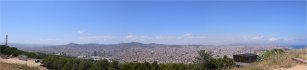 The fort also gives a wide panorama of the city of Barcelona.
 A big cable car goes down from the hill to the ramblas de mar on the harbour.