Brest
 Sheltered harbour
Almost at the western tip of Brittany, Brest is an exceptional setting, a huge sheltered harbour, which resulted in a valued strategic asset for the French navy.
 The Germans also valued and used it during WWII, and the city was subsequently thoroughly bombed at the end of the war, to be rebuilt in a 1950s concrete fashion, which lots of people hate, but I tend to like concrete.
 The Recouvrance bridge links both banks of the Penfeld river.

 Even close to the military zones dominated by concrete, the waters of the harbour can be clear and transparent. Sun and clouds create spectacular contrasts.

 East of the harbour, the river Élorn is crossed by two bridges, giving a broad view of the northern part of the harbour.
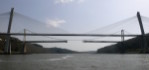 The harbour has also a big southern expanse, where you can then go up the Aulne river.

 While coming back to Moulin Blanc marina, we admired a sunset over the harbour. On another day, we left the harbour in the mist and met old gaffers.


 On a misty morning I crossed the harbour, leaving from the trade harbour, meeting the barquentine Pogoria, going in front of the Goulet, and getting a view of Brest’s sea side.


 Aboard Marie-Fernand, we sailed along the dredging sloop François-Monique as it came back to Brest harbour to moor in Tinduff harbour.
On the next Sunday, a friendly regatta gathered dredging sloops and other old gaffers.
 Trade harbour
Close to the city center, the trade harbour shelters fishing and passenger ships.


 It also welcomes visiting sailboats next to cranes, like the two-masted Fryderyk Chopin or the pilot cutter Marie-Fernand.

 The trade harbour also hosts huge tug boats, like Abeille Flandre, moored but ready to go any time the weather gets rough. Even their anchor is impressive.
 The Abeille Flandre has been replaced by Abeille Bourbon, an even bigger tug boat.
 On the quay, the chantier du Guip shipyard maintains and builds wooden boats, like the Chien Vert.
 A cargo terminal and a shipyard are further away from the Goulet, hosting foreign boats.
Château marina
The downtown Château marina was opened during the Brest 2012 festival, its seawall is a favourite walking spot of many Brest citizens.
 Among its visitors, it welcomed the Russian frigate Shtandart.
Old gaffers
La Recouvrance


 Close to the tug boats, there are old sailboats like La Recouvrance, on which you can sail. Its rigging is a very controlled tangle of sails, ropes and pulleys.


 Sailing for a day on this ship allows to discover Brest harbour in a very pleasant way.
La Recouvrance also goes on cruises, we sailed back from Aber Wrac’h to Brest.


 The day before, night fell on the figurehead of the ship. We left the harbour and met Notre-Dame de Rumengol; then we passed pointe de Saint-Mathieu before entering Brest harbour.
 Bergère de Domrémy
Bergère de Domrémy is a scallops dredging sloop built in 1936, classified as heritage monument. She is moored in the trade harbour and we learn how to sail her.

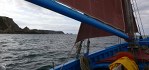
 I’ve sailed her under the Albert–Louppe bridge, to Camaret and in the harbour with La Recouvrance.
 In 2011, its mast was restored.


 We went with the Saint Guénolé to Camaret, and came back running.


 We also took part in the Kann al Loar festival, sailing up the Élorn river along with other boats one day, and coming back downstream
the next day, at sunrise.
We also took part in the Kann al Loar festival, sailing up the Élorn river along with other boats one day, and coming back downstream
the next day, at sunrise.


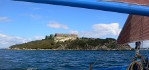 We explore the harbour, sometimes sailing around the Trébéron and Île des Morts islands, meeting other boats, like La Mouette.

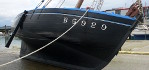
 In winter, we take care of the boat, painting pulleys, cleaning and painting the hull.
 In 2012, Bergère de Domrémy went to Lauberlac’h, south of the Plougastel peninsula.

 In 2013, she sailed along the boats racing the Sailing Tour de France in Brest harbour. She also took part in the maerl festival and came back at sunset.
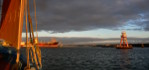
 She also sailed in the Goulet with Saint Guénolé. At the end of autumn, she came back in the trade harbour at sunset.
 Notre-Dame de Rumengol
The association which manages Bergère de Domrémy also safeguards a scow called Notre-Dame de Rumengol. On board this ship, I went along Portzic lighthouse.

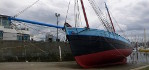 Each year, we careen the boat, resting on one side on the slipway, then on the other the next day.

 Once the careening is done, she can start her sailing season, like on this day in Brest harbour, getting close to Plougastel.


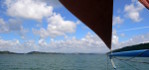 A few times a year, she travels up the Aulne river, going through Landévennec and its boat cemetery, under Terenez bridge, to Châteaulin.

 Following demand and maritime events, she goes further, for example northwards, passing by Le Four lighthouse and Portsall rocks to get to Corréjou.

 Saint Guénolé
Another old gaffer on which you can sail in the harbour is Saint Guénolé, a scallops dredging sloop with red sails built in 1948.
 Seagull
In the harbour you can also admire Seagull, a small classic yacht with superb lines.
Brest 2008
Every 4 years since 1992 (when La Recouvrance was launched), a big gathering of old gaffers and tall ships happens in Brest. Here are some of the ships during the 2008 gathering, in which I took part on my diving club’s boat.


Brest 2012
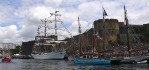
Here are some of the ships during the 2012 gathering, in which I took part aboard Marie-Fernand and Bergère de Domrémy.




 Arsenal
Between the city center and the Goulet, the military has seized all the coastline and created a big arsenal to build and maintain ships and submarines. You can catch glimpses of Brest castle between the legs of the biggest portal crane.


 In autumn, the sun sets behind the cranes of the arsenal, outlining the silhouettes of ships and cranes.
 Since 2008, the new marina built on the sunset side of the trade harbour has changed the view.
 Lots of areas in Brest and its surroundings are forbidden because they are used by the French navy. Downtown, the Penfeld river is a military zone with a masting crane and several workshops.
Maison Blanche
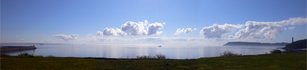 On the northern shore of the harbour, only a short length of coast is accessible between the 4 pompes road and Maison Blanche.

 It’s a popular walk, between the German submarine base and the Portzic lighthouse, with nice views of the harbour and a boat mooring area.
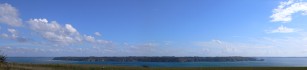 The Goulet
The Goulet (Narrows) is the entrance to the sheltered harbour of Brest.

 Its cliffs are rocky slopes, and it is overlooked by 17th century defence forts and second world war German machine gun bunkers.


 The Goulet opens out on the Iroise sea, sometimes under sun rays piercing through clouds.


 The entrance of the sheltered harbour is marked by the Portzic lighthouse, below which the Queen Mary passed. The top of the lighthouse is sometimes shrouded in fog.
 Opposite the lighthouse, the Cormorandière rock is situated at the entrance of the harbour.


 From the Portzic lighthouse, the coastal trail leads to the Sainte-Anne duPortzic cove, in the mist or under winter clouds.

 Further from the harbour, the Goulet widens. Pilot boats guide freighters with the delicate navigation when they enter the harbour.


 The entrance of the Goulet on the sea side is marked by the Petit Minou lighthouse. A bridge links the lighthouse to the shore.


 The lighthouse consists of 2 towers situated above the Petit Minou beach, which faces storms and so is a favourite of surfers for its waves.
 Coming back from Camaret, the coast is cut out against linear clouds.
Bertheaume cove
Out of the Goulet and out to sea, cliffs alternate with sand beaches.

 There are also rocky coves in the cliffs.
Sometimes cruise ships have a stopover in Brest, leaving through the Goulet.


 On the Trégana beach, waves roll and unfurl in foam.

 Waves also splash on rocks and the setting sun glistens on them.

 A tall sail ship waits in the cove before entering the harbour. A veil of fog clings to the shore. The Bertheaume fort closes the cove.
Pointe Saint-Mathieu


 The pointe Saint-Mathieu is the place where the coast turns to the north, marked by a lighthouse and a ruined abbey.
Coast


 The Corsen cape, north of Le Conquet, faces the Ouessant (Ushant) and Molène islands. Small sandy coves are sheltered between rocky granite capes.
 Towards north, the shore goes down to sea level. From the cape, you can enjoy sunsets at sea, behind the islands.
 Inland
Inland and northwest of Brest, the Kerloas menhir is a huge megalithic standing stone.